Showing posts with label scifi. Show all posts

Friday, August 25, 2017

Four Hestons of the Apocalypse

...from Apes to Apotheosis...

(originally published April 2015)


If Buster Crabbe is the Rudy Vallee of scifi thespians, then Charlton Heston is the Elvis. And like Crabbe, there is a certain thematic unity to Heston's work that bears examination.

In the 1950's, when Heston was a young actor, the USA experienced a perceptible increase in overt religiosity. No doubt this was some kind of collective reaction to the successive deprivation and horrors of the Great Depression and World War II, as well as a cultivated propaganda campaign of the early Cold War.

Indeed, in 1954, the US Congress voted into effect the national motto: 'In God We Trust,' ostensibly as a tribute to the bronze-age Hebrew war-god Yahweh, AKA Allah, AKA God. In 1957, US mints began printing the motto on paper money, uniting the two things Americans worship the most.

Sec. of State, John Foster Dulles, author of some of the USA's most aggressive imperialist actions, such as the Iranian Coup, made this statement in 1955:
  • “Our people have always been endowed with a sense of mission in the world. They have believed that it was their duty to help men everywhere to get the opportunity to be and do what God designed.”


During this period of theocratic exuberance, there was a string of big budget religious movies, such as Sampson and Delilah (1949), Quo Vadis (1951), and The Robe (1953). From the 21st century point of view, it's strange to contemplate the Religious Film as being a big box office genre, since such films are now mostly Direct to Home Video or a commercial flop, but it filled a distinct need in 1950's America. Religious films allowed Hollywood to traffic in violence, lust, and all the other salacious ingredients Americans prefer, but with a veneer of sanctimony, so that movie-goers could still feel sufficiently pious.


Victure Mature, as Biblical Beefcake in Samson and Delilah
The biggest of these films was The Ten Commandments (1956), which featured the young thespian Charlton Heston.  He had previously appeared in notable films such as The Greatest Show on Earth (1952) and The Naked Jungle (1954), but directors and the American filmgoer obviously sensed a certain ecclesiastical quality in him, because it was the beginning of a string of religious-themed epics featuring Heston:

  • Ben Hur (1959)
  • El Cid (1961)
  • The Greatest Story Ever Told (1965)
  • The Agony and the Ecstasy (1965)
The Heston Method

Although his acting style is not generally well-regarded by today's critics, Heston took his craft seriously and had high aspirations. While getting steady work in Hollywood A-pictures was no doubt appealing, he must have had misgivings about being Testamentary Typecast.

It was no doubt a fortuitous moment when Arthur P. Jacobs pitched Heston the idea for Planet of the Apes in 1965. Heston signed on the same day, and later participated in a short 'test reel' for 20th Century Fox, demonstrating the concept. 

Reading this article from the vantage point of the 21st century, it is worth a short side-trip into the history of Scifi film. Scifi cinema has trafficked in various apocalyptic scenarios since at least Things to Come (1936), but the sub-genre really came into its own in the 1950's. The need for low-budget product to fill the screens of America's drive-in theaters, combined with the potential thrills of Scifi and Atomic Age Anxiety, inspired a number of shoestring auteurs to produce a profusion of end-of-the-world epics. These films often opened with stock newsreel footage of exploding mushroom clouds and usually featured the desolation of Bronson Canyon or the Bronson Cave standing-in for a post-apocalyptic hell-scape. Robot Monster (1953)  and The Day the World Ended (1955) typify this group.


Humans fighting back against ape dominance in a post-apocalyptic Earth: the micro-budget Robot Monster (1953) strangely foreshadows Planet of the Apes.
Planet of the Apes (POTA) would be cut from different cloth. Costing almost $6 million to produce (in less inflated, 1968 dollars), it had an adequate budget, and an excellent cast and crew. The very fact that the story transpires on a ruined, post-apocalyptic earth is concealed until the last scene, although there are hints throughout the film. 


The Heston Method


POTA was released in early 1968, which turned out to be perfect timing for an apocalyptic Scifi film. Just a few weeks after the film's release, Walter Cronkite famously declared the Viet Nam war unwinnable, and was shortly thereafter followed the horrendous My Lai massacre. In April, and June, two eloquent and earnest political figures, MLK and RFK, beloved by millions, were respectively gunned down, shattering dreams for racial equality and peace.  In August, national TV broadcast live images of Chicago police brutalizing American youth at the National Democratic Convention. The self-righteous hypocrisy of American exceptionalism, the creed of the 1950's, was being challenged by disturbing realities.
By 1968, Americans had witnessed hundreds of civil rights marchers getting hosed. Now it was happening to a white guy.
A hard-hitting satire of race, religion, and politics, Planet of the Apes must have seemed like a bitter yet indispensable tonic. Its central conceit, to take a representative of the white male establishment, the most entitled species ever known on Planet Earth, and reverse his station, to humiliate him, cage him, cake him in filth, call him an animal and make him stand before a court of simian inquisitors, is Swiftian satire that remains potent after nearly 50 years.


The Heston Method

At the time of the film's production, Heston was mostly liberal in his political views, and decidedly anti-racist. There was no contradiction between the politics of the film and those of the thespian. 


Heston himself plays a character radically different from Moses or Michaelangelo, a hard-boiled, cynical, lusty, gun-toting, machismo American astronaut. This hero marks a significant step in the evolution of cinematic scifi, since most protagonists had heretofore been square-jawed hero types, ala Rex Reason, Gene Barry, or Leslie Neilsen.  

Heston would later describe Astronaut George Taylor in these terms: '...physically fleeing earth because of his contempt for man as a generally unsatisfactory animal. He finds himself thrust into the ironic situation of being the only reasoning human being in the anthropoid society, where he is forced to defend the homo sapiens whom he despises.This is a very interesting acting situation. I was of course fascinated by it...'

Yet in bringing to life such a character, there is more than cynicism and machismo, as evidenced by this excerpt from Astronaut Taylor's opening soliloquy:
  • 'I leave the 20th century with no regrets. But one more thing - if anybody's listening, that is. Nothing scientific. It's purely personal. But seen from out here everything seems different. Time bends. Space is boundless. It squashes a man's ego. I feel lonely. That's about it. Tell me, though. Does man, that marvel of the universe, that glorious paradox who sent me to the stars, still make war against his brother? Keep his neighbor's children starving?'
Might these sentiments have also fit one of the actor's ecclesiastical performances as well?

Being as it is a satire of religious hypocrisy, it makes sense that POTA is full of quasi-scriptural language. Dig this quote from the simian holy book:
  • 'Beware the beast Man, for he is the Devil's pawn. Alone among God's primates, he kills for sport or lust or greed. Yea, he will murder his brother to possess his brother's land. Let him not breed in great numbers, for he will make a desert of his home and yours. Shun him; drive him back into his jungle lair, for he is the harbinger of death.'
But the concept of Apocalypse itself comes to us from religion. Nuclear War and the other technological horrors of the 20th century had merely brought Apocalypse back into style after a thousand year hiatus.

The POTA script, and the final, sucker-punch scene, strongly imply that the planet was the victim of war. War of course, is one of the famed Four Horsemen of the Apocalypse, from the Biblical Book of Revelation. The Four Horsemen are typically identified by Christian Mythologists as follows: Conquest, Pestilence, War, and Famine.

Planet of the Apes was a mega-blockbuster and a genuine cultural phenomenon, grossing over $20 million in 1968 dollars, recapping the production cost more than threefold. A sequel was inevitable.

Mr Heston was not enthusiastic, but agreed to it, citing a feeling of obligation to producer Arthur P Jacobs. The Flapdoodle Files suspects that the actor also wanted to put a few more miles between himself and the cinematic Holy Land.


Beneath the Planet of the Apes was released in 1970, and was another hit for both 20th Century Fox and Heston.  It is, admittedly, somewhat loopy, but good apocalyptic fun is still to be found. There is a particularly enjoyable speech by the Elvis of Sleaze, the great James Gregory, as General Ursus, as he eggs the ape parliament onward toward an invasion of the Forbidden Zone. Watching the film today, the Ursus speech is strikingly familiar to watching the primates on our current 24-hr cable news channels, egging us onto our next campaign of military aggression.  This film corresponds to the Horseman Conquest.


The Heston Method
BTPOTA is also graced by the presence of an underground cult of H-Bomb worshiping telepathic mutants. Since the film ends with the detonation of a world-destroying mega-bomb, one could say this film shows the power of prayer.

By this time, Heston was though with the Planet of the Apes but not finished the Apocalypse. While flying on a passenger jet, he chanced to read Richard Matheson's novel I Am Legend and became interested in its adaptation to cinema, seemingly unaware that it had been previously by an Italian producer under the name The Last Man on Earth (1964) starring the brilliant but effete Vincent Price in the titular role. 

The Heston version was titled The Omega Man (1971) and takes many liberties with the source material. In the film, Heston plays a hard-boiled, cynical, lusty, gun-toting, machismo Army doctor, whose blood is uniquely and mysteriously immune to a strange post-apocalyptic plague of zombism.  This film corresponds to the Horseman Pestilence

Although this was Heston's third go at apocalyptic scifi, his leading lady, Rosalind Cash, balked at doing a nude love scene with him, citing her own reluctance to "screw Moses." Despite his efforts so far, the Biblical aura was still clinging to the craggy thespian.


The Omega Man is a harbinger of changes in Heston's political views. Instead of being a bearded, dirty, hippiesque type of hero, as he was in Planet of the Apes, in this film he is clean-shaven, wears a smoking jacket and ascot, lives in a plush apartment, drives a Detroit land-yacht, eats caviar and drinks expensive whiskey. Not quite a square, he nonetheless embodies The Man. He is menaced and persecuted by a bizarre counterculture zombie cult known as The Family, likely inspired by The Manson Family. 


To put it bluntly, The Omega Man is not a good film, suffering from a daffy script, uninspired photography, and overall inept direction. It is of value mainly to film historians, to scholars of the Fantastique, and to hecklers.  Despite its failings, however, due credit should be given to its clumsy director, Boris Sagal, for having the guts to create the film's final image, a crucifixion parody/homage, underscoring the fact that Our Hero saves the world by shedding his blood. A little bit of sacrilege worthy of our admiration, yet at the same time, revealing a messianic ego. 


The Heston Method
Heston's final apocalyptic scfi film was Soylent Green (1973), which contains the earliest cinematic usage the term 'Greenhouse Effect' known to the Flapdoodle Files. Soylent Green (SG) features Heston as the hard-boiled, cynical, lusty, gun-toting, machismo detective Frank Thorne, in the near future year of 2022. SG transpires in an NYC trapped in perpetual summer (due to the Greenhouse Effect), overpopulation, food scacrity, resource depletion, 50% unemployment, and a disintegrating infrastructure. A whodunnit set amidst extreme urban decay and masses of ragged homeless people crowding every available inch, there is a disquieting plausibility to SG which only increases as the years pass and our own prognosis grows ever worse. While NYC doesn't look quite like Soylent Green yet, a few cities, like Rio and Mumbai, look worse.


Viewers accustomed to the spectacular battles and dazzling special effects of the post Star Wars era will perhaps be perplexed by SG, which uses the format of a police procedural to tell its own particular apocalyptic story, which corresponds to the Horseman Famine. The gritty dystopian whodunit is interspersed with enjoyable expository scenes featuring Heston alongside the great Edward G. Robinson, in what would be his last role.


Although unlike anything made in recent years, Soylent Green is an excellent film and its social commentary is even truer now than in 1973. Approaching from another angle, we note that Robinson's character is named Sol, evoking both a disciple of the legendary demi-god Jesus and the Roman emperor who made the Jesus-cult a State Religion. The name is likely not coincidental, since the movie features a famous sequence featuring Sol's voluntary surrender of his own life and technological transubstantiation into foodstuff, echoing the ritual of Christian Cannibalism.

The Heston Method
It is a testimonial to the impact of Soylent Green that almost no reader was shocked by that last spoiler, just as no readers were shocked when we mentioned that Earth is really the Planet of the Apes. The film was a box-office success, and mostly approved by the critics.

This would be Heston's final apocalypse, with the thespian moving on to supporting roles in a number of genres, then to TV soap-opera, and then to lesser roles. He had broken through his ecclesiastical typecasting and had somehow avoided being completely pidgeonholed in scifi.

The Four Hestonian Apocalypses, each from a different director, each a divergent vision of the apocalypse, have an accidental quality of unity. Each features the former Moses as a hard-boiled, cynical, lusty, gun-toting, machismo protagonist, trying to make sense of a world gone mad. Heston serves as a kind of Gulliver, traveling between these strange worlds.

At the same time, Heston's hard-boiled, cynical, lusty, gun-toting, machismo scifi hero has become a genuine archetype, forming the basis for multiple performances by Harrison Ford, Arnold Schwartzenegger, Kirk Russell, Bruce Willis, and others. 

In the meantime, America and it's middle-class experienced a continuation of the national traumas and culture shocks which had begun with the 1968 Planet of the Apes release. The Stones at Altamont, the Mansion Murders, the Kent State Tragedy, the Patty Hearst kidnapping and the drug-related deaths of numerous promising young rock and roll artists disheartened the youth movement. Concurrently, the bills for the Viet Nam war started to come due, corporations began to move their factories overseas, and Oil Shock combined so that, after 25 years of gains, the American middle-class began its long (and as yet unabated) slide backwards.

Heston himself seemed to have misunderstood what was happening to America, perceiving it as being somehow a set of misfortunes exclusive to the white heterosexual male, as opposed to the generalized and widespread deprivation that actually existed. His final role, as a right-wing fundraiser and president of the NRA, afforded him a high profile platform to utter shocking, offensive, and surreal soliloquies such as these:

  • "I find my blood pressure rising when [the President]'s cultural shock troops participate in homosexual rights fund raisers but boycott gun rights fund raisers - and then claim it's time to place homosexual men in tents with Boy Scouts and suggest that sperm-donor babies born into lesbian relationships are somehow better served."
  • "The Constitution was handed down to guide us by a bunch of those wise old, dead, white guys who invented this country. It's true - they were white guys. So were most of the guys who died in [Abraham Lincoln]'s name, opposing slavery in the 1860s. So, why should I be ashamed of white guys? Why is Hispanic pride or black pride a good thing, while white pride conjures up shaved heads and white hoods?"
For a rich white heterosexual man who had lived the greater part of his life with the privileges of a fame and wealth to argue that white heterosexual men were an oppressed group in the America of the 1990's is certainly an endeavor of the imagination. Heston's evolution from celluloid thespian to a Right Wing Talking Head, to his final cameo performance as an elderly and infirm man in Michael Moore's Bowling For Columbine is perhaps more similar to the Reality TV Star than it is to the Performance Artist, however. 

The Heston Method

In fairness, Charlton Heston's emergence as a right-wing bloviator coincides with the Angry White Man movement of the 1980's and 1990's, in which millions of self-pitying Caucasians blamed the falling fortunes of the middle-class on Affirmative Action, Ebonics, liberals...anything but the structural economic forces actually at work.

Apotheosis is the term to describe the process by which ancient heroes or kings became transformed, in the imagination at least, from mere mortals to gods.  Charlton Heston began his career as an ordinary actor, appearing in westerns, crime stories, and other genres but at a critical moment in cinema history became so closely identified with religious heroes that in the mind of the public, the borders began to blur.  

In the seemingly-secular realm of scifi, each his characters each confronted the apocalypse, a concept with origins in ancient religions, and there is a strange messianic quality in these performances. The final chapter of his life, as a professional demagogue, thrust his own personality, or at least the simulacrum of it, into the public eye, upon the stage of the 24-hour TV news cycle. 

Even now, 7 years after his death, the NRA website has immortalized Heston's speeches, in all their racist/homophobic dog-whistling glory, echoing across the globe via the information superhighway.  

Alternatively, while his Biblical and religious-themed films are seldom seen today, the original Planet of the Apes is still in regular rotation on classic movie channels and scifi film festivals, and Astronaut Taylor preserves the memory of Heston for millions of viewers. 

An Old Testament prophet, the Last Man on Earth, an Angry White Man...a living technicolor memory, transmitted digitally, toward an undefined apotheosis... 


Wednesday, July 8, 2015

The Obvious and Mundane Origins of the Green Lantern


The Green Lantern (GL) is a comic book superhero, whose best and most famous incarnation was first published in 1959 (Showcase #22) by editor Julius Schwartz, writer John Broome, and artist Gil Kane. Although GL has never achieved the rock star status of Spider-Man, the X-Men or Iron Man, he has maintained a loyal fanbase since his creation and his comic books enjoyed robust sales during his first few years of publication.

Green Lantern was the second super-hero success of the famed Silver-Age of Comic Books. The silver-age was a period of high creativity, high quality and high sales which lasted from 1956 to about 1969, during which superheroes were predominant. 

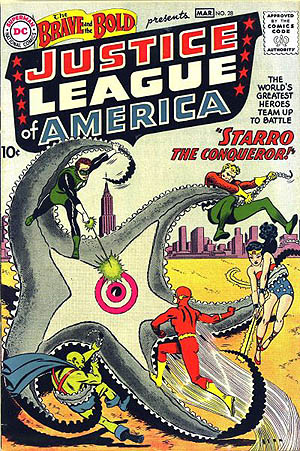
While Green Lantern never became a household word, he is of vital importance because after Julius Schwartz and his partners successfully launched the Silver-Age with the premiere of The Flash in 1956, GL was the follow-up. GL proved that The Flash was no fluke, and shortly after GL appeared, Julie Schwartz and co. introduced the Justice League of America (1960), which turned out to be a very successful club for superheroes. GL was a founding member of the Justice League, present at their first adventure:


Julie Schwartz worked for DC Comics, who also published Superman and Batman. One of their rivals was Marvel Comics, who saw the high sales of the Justice League and Julie Schwartz's other superhero comics. Spotting a trend, Marvel Comics created Spider-Man, the X-Men, Iron Man, the Fantastic Four, Thor and the Avengers, all of whom have been adapted into commercially successful films in the 21st century. Indeed, it is the Flapdoodle Files' considered opinion that comic book superheroes represent the most prominent trend in Fantastique Films in the last 15 years. GL is the essential second link in a chain of events which led directly to this movement in cinema.

All comic book fans know the Green Lantern, but hopefully they will excuse a brief explanation for the benefit of the superheroically illiterate: The Green Lantern is test-pilot Hal Jordan, chosen by an advanced alien race for his moral qualities to become a kind of interplanetary policeman. His single weapon is a fantastic Power Ring, which carries him through air and space, and shoots multi-purpose ray beams which have more versatility than even a Swiss Army Knife and an Iphone combined. 

In February 2015, an astute blogger published his hypothesis that GL's 1959 creation  was inspired by an supposedly true (but later exposed as a hoax) alien contact incident involving real people:


Since the Green Lantern's creators, Julius Schwartz, John Broome, and Gil Kane are all dead, and since there is no record of any of them specifically talking about alien abduction mythology, we must admit that the claim is potentially true.  

Despite this, there are two more obvious and accessible sources for the inspiration. 

The first source is of course the famous Doc Smith Lensman scifi novel series (1948-56), concerning a an elite group of humans selected by an advanced race for service in the Galactic Patrol, and each given a special device called the Lens.  The Lens gives its wearer a variety of mental capabilities, including those needed to enforce the law on alien planets, and to bridge the communication gap between different life-forms. It can provide mind-reading and telepathic abilities. It cannot be worn by anyone other than its owner, will kill any other wearer and even a brief touch is extremely painful. Schwarz himself, a long-time scifi editor and literary agent, acknowledged that the Lensman had inspired him.

GL stands for Gray Lensman. Classic cover art. Note the titular Lens on the hero's right wrist.
No one disputes this, and the blogger in question duly credits the Lensman as well. 

It is the injection of the allegedly true 'alien contact' mythology where the Flapdoodle Files parts ways. 

The Green Lantern we all know was first published in 1959. Four years earlier, Universal Studios had released their scifi film This Island Earth (TIE). The film cost $800K to produce, and the box office was $1,700,000. Since the average ticket cost was 50 cents, we can estimate that over 30 million people saw the film. TIE was undisputedly the most opulent and spectacular scifi film of 1955.


Nowadays, TIE is probably best-known as the subject of hilarious ridicule via Mystery Science Theater 3000. While fun is fun, and while TIE is a flawed film (the script starts off promisingly, but then in the final third of the film it takes a detour to Planet Nowhere), we should not underestimate its importance. 


TIE is one of the first feature films to depict the an alien planet, complete with alien buildings. And it is the earliest Space Opera feature film, and the earliest feature film to depict any kind of space battle. By 1950's standards, it was a true cinema spectacular, comparable to 20,000 Leagues Under the Sea, War of the Worlds, and Forbidden Planet.


By the time of TIE's release (1955), Schwartz, Broome and Kane (along with other members of the DC bullpen) had for 5 years been turning out scifi comics by the carload to fill the pages of DC's Strange Adventures and Mystery in Space magazines. Schwartz himself had been working on scifi magazines and as a literary agent for scifi writers since the 1930's.


These creative workers, trafficking in fantastic visuals and ideas, in those days before the internet, would not have been likely to miss out on an opportunity for potential inspiration, another source from which they might borrow fantastic visuals or ideas. It would have been truly odd if none of GL's creators saw TIE.

Early in TIE, square-jawed scientist and jet jockey Rex Reason is shown flying a T-33 jet trainer which flames out and appears to be headed for doom. But then suddenly, an eerie green glow surrounds the plane and brings Our Hero and his plane safely to earth. 


(Later on in the picture, Rex Reason is again using his pilot's license, this time in a small prop plane, when he, his passenger, and his craft are abducted into an alien spaceship by means of another powerful green beam!)


A powerless jet-trainer, then a small prop plane, both carried by green alien ray beam.

Now let's look at a couple pages from the classic Kane/Broome origin story:


The splash page clearly shows a jet-jockey in the cockpit of a flightless trainer, carried through the air by a green energy beam. This is the image that the creators chose for the first page of the story, designed to be interesting and exciting so as to compel a comic book reader to buy the magazine.

Now let's look at a page from the interior of the story:


So the actual story also shows the green ray scooping up the trainer and the jet jockey. The square-jawed jet-jockey, whom we see in the lower right-hand panel wearing the brown fight coveralls is test pilot Hal Jordan.  As all comic book fans know, Hal was destined to become the Green Lantern of Space Sector 2814, which happens to be the sector where Earth is located.

Now let's take a look at TIE's square-jawed jet-jockey, Rex Reason, shown here on the left sporting a flight suit:


The brown flight suit here is similar to Hal Jordan's. But below is a still, from another film, which is a better representation of Reason's square-jawed aviator machismo: 


Even though this is not from the actual movie in question, this pic does show that Rex Reason makes a swell jet-jockey, as he did in TIE.

Rex Reason's character in TIE is named Dr. Cal Meacham. Besides the fact that he is a square-jawed jet-jockey, Meacham has personal and intellectual qualities desired by race of alien beings for a special project of great importance. The alien race test Cal's fitness for this project by sending him the parts for a super-advanced telecommunications device and ray weapon called the Interociter...when Cal is able to properly assemble the device, it means he has passed the aliens' test.


Like Dr. Meacham, Hal Jordan is also selected by an advanced alien intelligence for project of great importance. But in GL's story, he is tested by the fantastic power of the lantern (and passes!) instantly:


Another connection between TIE and the Green Lantern is that both feature Aliens With Big Heads. In TIE, these are embodied by the inhabitants of the planet Metaluna. It is this advanced alien race which determined the fitness of square-jawed jet-jockey Rex Reason for the Metalunans' cosmic scheme. Here we see a few of the Metalunans, enjoying the company of TIE's female lead, the lovely Faith Domerique:


Although not shown in the first appearance of our hero, the Green Lantern continuity also established an advanced race of Aliens With Big Heads (premiering in Green Lantern #1, 1960). This group lived on the distant planet Oa, and they had in ancient times established themselves as The Guardians of the Universe (not to be confused with Marvel Comics' Guardians of the Galaxy, which came a decade later):


Of course, TIE is not the first appearance of Aliens With Big Heads. By the end of the 1930's, pulp magazine illustrations had already featured some Aliens With Big Heads and 1939's Wizard of Oz (as he appeared in hologram form) also fit the description.


A year prior to the Wizard of Oz, by the way, Orson Wells' famous radio drama of War of the Worlds was (by design) mistaken by thousands of listeners to be a newscast of a real alien invasion. This is one of the major milestones in the creation of the widespread 20th century belief that Creatures from Another Planet would visit Earth. 

Speaking of Orson Wells, the radio/film auteur guest-starred in a 1950 Superman story about hostile Martians. This tale also featured Aliens With Big Heads:


Aliens With Big Heads figure prominently into the UFO Contactee and Alien Abduction mythologies. I mention that because it is the considered opinion of the Flapdoodle Files that most if not all elements of alien visitor mythologies have precursors in the realm of fiction, be it literature, comic books, scifi films, radio dramas, etc. This of course also applies to the whole idea of alien visitation in general.

Like big-headed aliens, a desert setting is also found in many UFO contactee/abduction stories. Blogger Gregory L. Reece, to whom I referred earlier in this article, makes much of the fact that the hoax UFO contact incident which he connects with the origins of GL took place in the deserts of the American Southwest. For indeed, Hal Jordan's fateful encounter with the space-wrecked alien and the power ring did take place in an isolated desert setting.

But beginning with the Manhattan Project of WW2, and the Roswell Incident of 1947, the deserts of the Southwest have been a hotbed of folklore regarding secret weapons and legends of paranormal activity. Andrews Airbase, White Sands, Area 51. The southwest was the natural habitat of test pilots and the preferred place for UFO's to land or crash.


Square-jawed jet jockey Peter Graves gets an unpleasant medical exam in Killers From Space (1954).
(for more on this fascinating film, see..
Killers From Space and Alien Abductions )
A plethora of 1950's scifi films such as Radar Men from the Moon (1952), Zombies of the Stratosphere (1952), Robot Monster (1953),  Killers From Space (1954), It Conquered the World (1956), Kronos (1957), and Attack of the 50-Foot Woman (1958) all feature alien contact incidents which transpire in the desert. By 1959, an alien space ship in the American desert was a bona fide trope.


Space aliens meeting with humans in the desert. Zombies of the Stratosphere (1952)
Regarding alien contact with humans, one of the first scifi writers to fully exploit this concept was HP Lovecraft. Late in his life, Lovecraft was represented by the Solar Sales Service literary agency. Solar Sales was founded by Julie Schwartz, in partnership with another future DC editor, Mort Weisinger. Solar Sales also represented Alfred Bester, Robert Bloch, Ray Bradbury, and other scifi writers.

Speaking of Ray Bradbury, it was he who wrote the original story treatment for the seminal scifi classic It Came From Outer Space (1953). The plot of this film concerns an alien whose spaceship has crashed in the Arizona desert and involves multiple instances of 'contact' with local humans.


Alien craft, marooned in the Arizona desert: It Came From Outer Space
The point being is that by 1959, Schwartz had been immersed in scifi for 25 years, and I suspect he would have been hard-pressed to name one specific alien contact 'incident' or story idea to have inspired the creation of the Green Lantern. 

The modern era of UFO's, which began with Kenneth Arnold's sighting of flying discs over the Cascade Mountains in 1947, came 25 or so years after scifi became popularized by pulp magazines, and 11 years after the first Flash Gordon movie serial. It seems likely that scifi concepts influenced the way people perceived blurry images in the sky and other ambiguous experiences, creating a whole new mythology.

But as soon as alleged first hand 'true' accounts of UFO's and then, later, contact with aliens, were published, scifi writers cribbed from them, creating a continuous feedback loop. By 1959, sorting out whether a scifi story was influenced by other scifi, or by a dubious 'true' alien contact story, is every bit a chicken-or-the-egg enigma.

Regarding cross-cultural influences, we now switch from Alien Invasion to the British Invasion. No scholarly discussion of the Green Lantern should omit a reference to Donovan, whose 1966 hit song 'Sunshine Superman" includes the following immortal couplet: 
"Superman or Green Lantern ain't got nothin' on me
I can make like a turtle and dive for pearls in the sea..."


Many years later, the psychedelic troubadour would explain his Green Lantern reference in this way:

'...As for the title, “Sunshine” was a tag describing acid. LSD was legal and pure then. We were experimenting with it, as were poets, scientists and philosophers. I was relating “Superman” to Nietzsche, about this idea of the Superman of the future who would be totally enlightened and using the full potential of his brain and heart and soul. But I also love comic books, so that’s why I sang about the Green Lantern, too. Comic books are mythological. The superhero in my song is everybody. We can all become the superhero of ourselves.'
(emphasis courtesy of the Flapdoodle Files)

Like Cal Meacham or Hal Jordan, anyone is eligible to be carried away by the powerful alien energy of an unexpected adventure. This also is the attraction of the UFO-contactee hoax/delusion...that at any moment, an ordinary person might unexpectedly be selected by advanced alien intelligence to play some special part in the human drama, and an ordinary life might be transformed. 

For our money, we prefer the fantasies peddled by the likes of Julie Schwartz, John Broome, Ray Bradbury, Donovan, etc. Fantasy is a conscious exercise of the creative imagination, and as long as it is not out of one's own control, it can be liberating and empowering. Whereas the imagination subverted by the lies of charlatan or hobbled by delusion is anything but liberated.


*********************************************

There is one possible connection to the Green Lantern that remains an unsolved mystery to the researchers of the Flapdoodle Files. 

In 1957, the Japanese studio Shintoho released the first of several kiddie scifi films to feature the  superhero Super Giant, whose adventures would be eventually exported to the USA under the name Star Man. Super Giant possessed a super-wristwatch kind of device which allowed him to fly through space and do other amazing things, and it was given to him by the advanced alien beings of The Emerald Planet:


The high council of the Emerald Planet resembles one of the recurrent features of the Green Lantern comics, which is the vast host of interplanetary beings employed as space patrol members by the Green Lantern Corps.

High Council of Emerald Warriors

And of course, Super Giant/Starman comes from The Emerald Planet. Emerald, as in Green (GL himself is frequently referred to as 'the Emerald Warrior'). 


High Council of the Emerald Planet

These similarities should not be coincidental. Yet, in fact, they may be. Super Giant/Star Man was not imported to the US until the mid-1960's, well after GL and the vast corps of alien Green Lanterns had been established. And as a low-budget, kiddie flick, it is not likely to have gotten any attention in the US prior to distribution on US TV. 

But perhaps the answer lies in going back a step. Everyone agrees that Schwartz and Broome were influenced by Doc Smith's Lensman novels, published from 1948-54. Super Giant/Star Man might simply be another galactic patrolman patterned after one of Doc Smith's Lensman, with certain images being coincidental resemblances.  


Super Giant/Star Man himself, while being a kind of galactic patrolman similar to GL, looks nothing like GL. 

And so far as the Flapdoodle Files research goes, no claims of a link between Super Giant and UFO contactees have been discovered. At least, so far...